A few months back, a Jaipur based skincare brand walked into one of my calls with a simple complaint. Their Meta Ads were “not working.” Cost per lead had gone up, the founder was frustrated, and the first question I asked was not about the ad account at all. I asked, “What is your customer lifetime value?” There was silence on the call. Nobody had ever calculated it.
That one number changed the entire conversation. Once we worked out their customer lifetime value, their so called “expensive” ad account suddenly looked profitable, because their customers were not buying once. They were buying three, sometimes four times a year. This is the story of almost every D2C and ecommerce brand I work with in India, and it is exactly why I am writing this guide.
What Is Customer Lifetime Value?
Customer lifetime value, often written as CLV or LTV, is the total revenue or profit a business can expect from a single customer over the entire time that customer keeps buying from them. It is not about one transaction. It is about the full relationship.
Most business owners only look at the first sale. They calculate cost per acquisition, compare it to the first order value, and decide whether an ad campaign “worked.” But that view is incomplete. A customer who spends ₹1,500 once is very different from a customer who spends ₹1,500 five times a year for three years.
CLV vs One Time Purchase Value
A one time purchase value tells you what happened today. Customer lifetime value tells you what is likely to happen over the next few months or years. This difference matters enormously when you are deciding how much you can afford to spend on Google Ads or Meta Ads to win a new customer.
Revenue vs Profit in CLV
There are two common ways businesses calculate this metric. Revenue based CLV looks at total sales generated by a customer. Profit based CLV subtracts cost of goods, shipping, returns, and other expenses. For paid media decisions, profit based CLV gives a far more honest picture, though revenue based CLV is easier to calculate and a good starting point.
Customer Lifetime Value Formula (Simple and Practical)
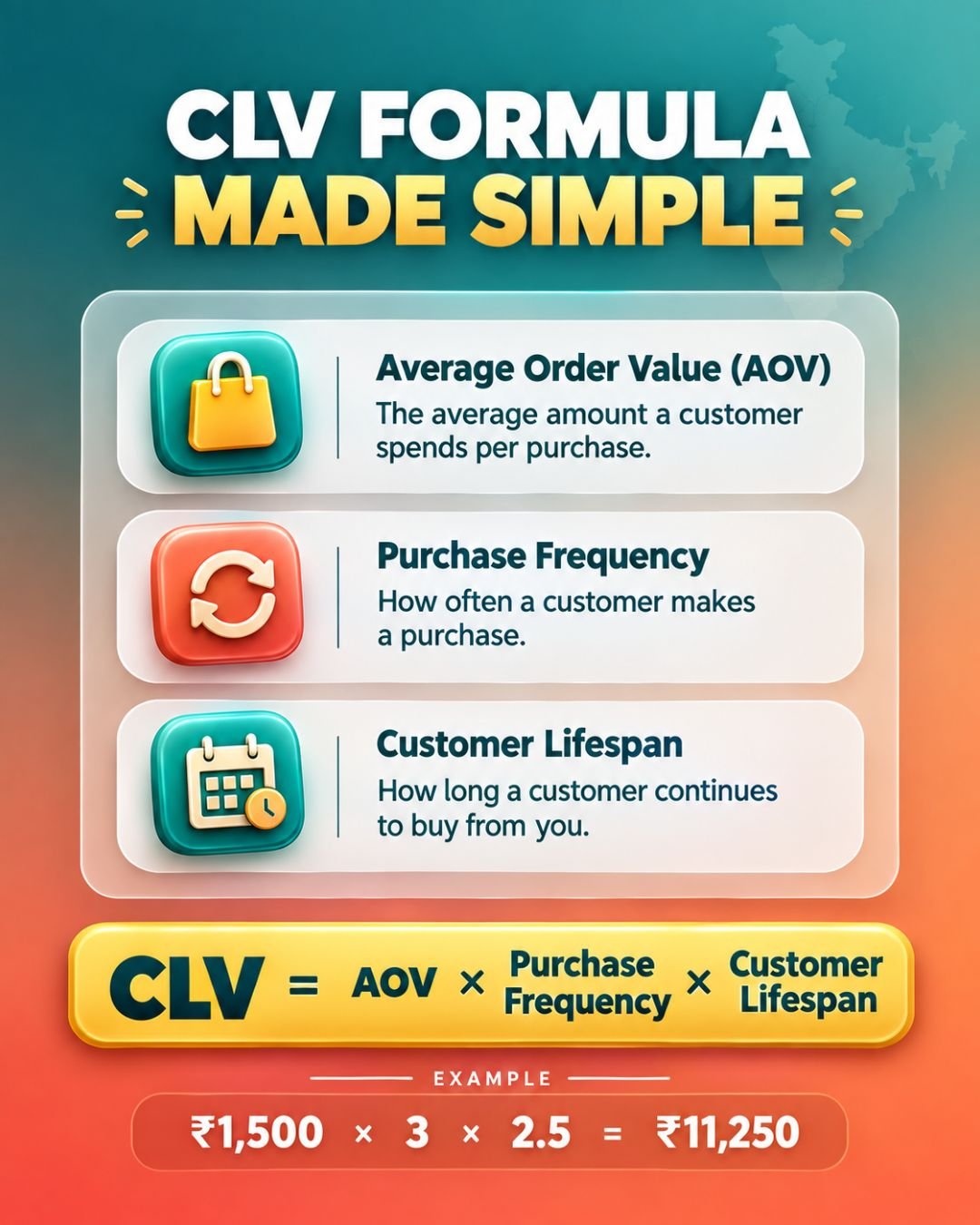
The basic customer lifetime value formula that most marketers and ecommerce platforms rely on is straightforward.
CLV = Average Order Value × Purchase Frequency × Customer Lifespan
Let’s break down each part.
Average Order Value (AOV)
This is the average amount a customer spends per order. You calculate it by dividing total revenue by the total number of orders in a given period.
Purchase Frequency
This tells you how often an average customer buys from you in a year. Divide total orders by the number of unique customers to get this number.
Customer Lifespan
This is the average number of years or months a customer continues buying from your brand before they stop. For subscription businesses this is easier to track. For ecommerce brands it usually needs an estimate based on past customer behaviour.
Customer Lifetime Value Example in India
Numbers make this concept click faster than definitions, so here is a real style example using Indian rupees.
Imagine a D2C skincare brand with the following data:
- Average Order Value (AOV): ₹1,500
- Purchases per year: 3
- Average customer lifespan: 2.5 years
Using the formula:
₹1,500 × 3 × 2.5 = ₹11,250
This means an average customer is worth roughly ₹11,250 to this brand over their relationship, not just the ₹1,500 they spent on their first order. This single insight changes how a founder should think about acquisition spend. If their cost to acquire a customer through Google Ads is ₹800, the picture suddenly looks very different from a founder who only looks at first order ROAS.
Keep in mind this is a revenue based number. To get a profit based figure, you would need to subtract product cost, shipping, payment gateway charges, and returns.
How to Calculate CLV Step by Step
If you want to calculate this for your own business, here is a simple process I use with clients.
- Pull order data for the last 12 to 24 months from your store or CRM.
- Calculate your Average Order Value by dividing total revenue by total orders.
- Calculate purchase frequency by dividing total orders by unique customers.
- Estimate customer lifespan by looking at how long repeat customers typically keep buying before they go inactive.
- Multiply AOV, purchase frequency, and lifespan to get your basic CLV.
- Apply your gross margin percentage if you want a profit based figure instead of a revenue based one.
This does not need to be perfect on day one. Even a rough estimate is better than making acquisition decisions with no lifetime data at all.
Customer Lifetime Value vs CAC
Once you know your customer lifetime value, the next logical step is comparing it against your Customer Acquisition Cost, or CAC.
CAC = Total Acquisition Spend ÷ New Customers Acquired
From here you get the LTV to CAC ratio.
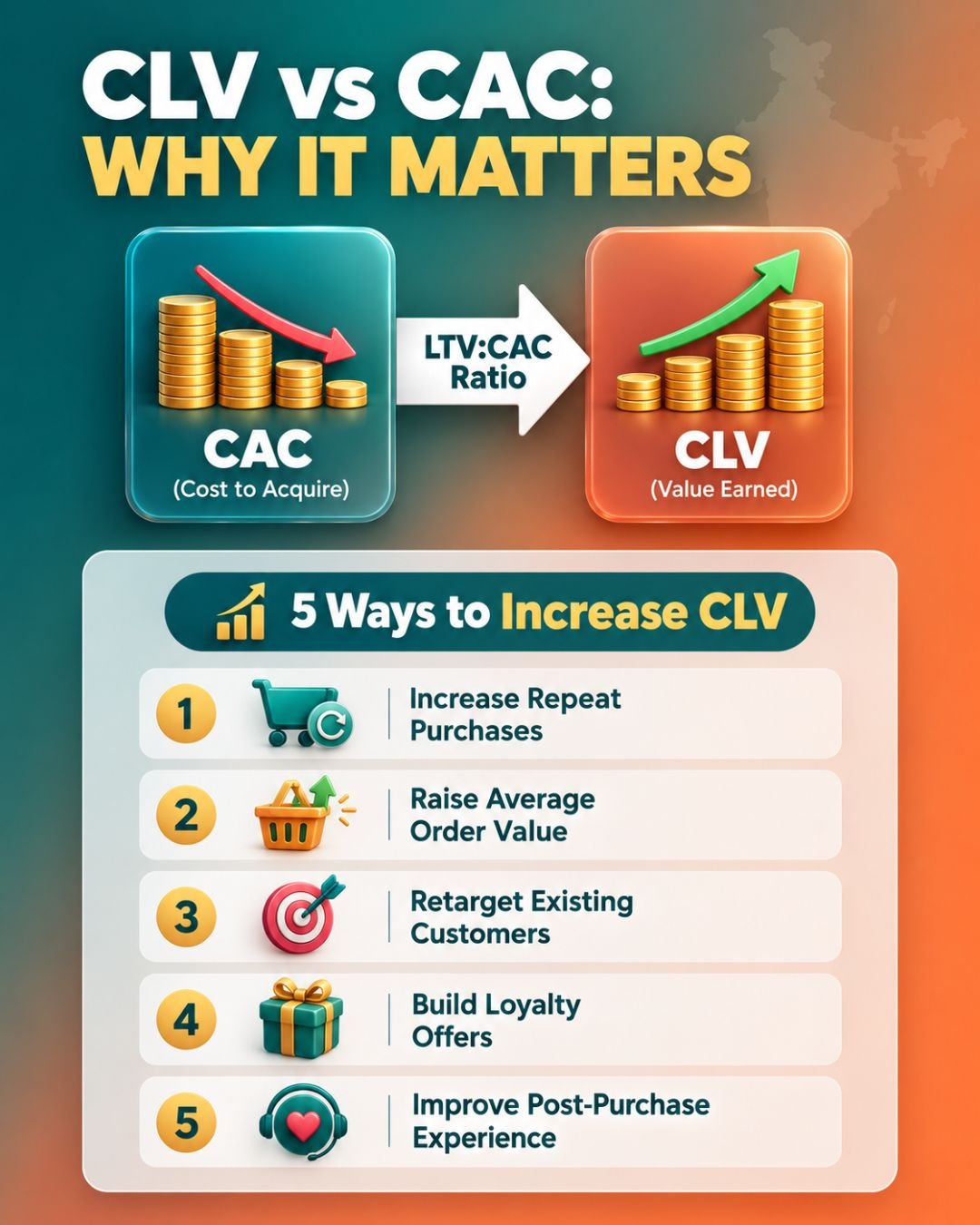
LTV:CAC = CLV ÷ CAC
A 3:1 ratio is commonly mentioned as a healthy benchmark across the industry, meaning a customer is worth roughly three times what it costs to acquire them. I want to be honest here though. This is not a universal rule. A high margin skincare brand and a low margin grocery delivery business will have very different healthy ratios. Treat 3:1 as a starting reference point, not a rulebook.
Why CLV Matters for Digital Marketing in India
I run paid ads for a living, and this metric changes almost every decision I make for a client account. Here is why it matters so much.
- It tells you how much you can realistically spend to acquire one customer without losing money long term.
- It helps you decide which channels bring genuinely valuable customers, not just cheap first time buyers.
- It supports smarter customer segmentation, so you can build separate campaigns for high value repeat buyers.
- It improves how you judge campaign performance, moving the focus beyond first order ROAS.
- It guides retention marketing budgets, since keeping an existing customer is almost always cheaper than acquiring a new one.
When a founder understands their customer lifetime value, budget conversations stop being emotional and start being strategic.
How to Increase Customer Lifetime Value
Improving this number is where the real growth work happens. A few tactics that consistently move the needle for the brands I work with:
- Increase repeat purchase rate through timely email and WhatsApp follow ups.
- Raise average order value using product bundles or minimum spend offers.
- Introduce cross selling and upselling at checkout.
- Build a simple loyalty or rewards program for repeat customers.
- Improve the post purchase experience, from packaging to delivery updates.
- Retarget existing customers with relevant offers instead of only chasing new audiences.
- Fix any friction in the return or replacement process, since a smooth return builds trust for future orders.
Two quick tips I always share with clients:
Tip 1: Calculate CLV separately for each customer segment, acquisition channel, and product category. A single average number often hides big differences between your best customers and your one time buyers.
Tip 2: Never judge a paid campaign purely on first order ROAS. Compare your CAC against expected customer lifetime value before deciding whether a channel is actually working or not.
How CLV Improves Meta Ads and Google Ads Decisions
This is the part most CLV articles skip, and it is exactly where my work lives day to day.
A customer might come in through Meta Ads with a low first order ROAS. On paper that campaign looks weak. But if that same customer returns two or three more times over the next year, the true value of that campaign is much higher than the first order suggests. This is why I always evaluate accounts using CAC alongside first order revenue and expected repeat revenue, not first order numbers alone.
If you want to see how I evaluate ad account performance in more depth, I have written about this in my guide on the Meta Opportunity Score, which helps identify where an account is actually losing efficiency.
Accurate tracking matters just as much here. Without clean data, your CLV and CAC numbers will be off from the start. I cover the full setup process in my Google Ads conversion tracking guide, which is worth reading before you try to scale spend based on lifetime value assumptions.
For brands scaling their search campaigns while keeping an eye on long term customer value, my breakdown of AI Max for Search campaigns explains how automation is changing acquisition strategy in India right now.
CLV for Indian D2C and Ecommerce Brands
India is not one single market, and customer lifetime value looks very different depending on the category you are in.
- Fashion and beauty brands often see high purchase frequency but heavy discount dependence.
- COD heavy categories need to factor in return rates before trusting a revenue based CLV number.
- Subscription and wellness products usually have a longer, more predictable customer lifespan.
- Food and grocery brands tend to have high frequency but lower AOV, which changes how you think about acquisition budgets.
- Service based businesses may have fewer transactions but much higher order values.
There is no single Indian benchmark that applies to every business. The right move is measuring your own numbers by segment rather than borrowing a benchmark from a different category.
Customer Lifetime Value and Customer Retention
Retention is the engine behind every strong customer lifetime value number. A brand can spend heavily on new customer acquisition, but if those customers never come back, the CLV stays low no matter how good the ads look on the surface.
I have seen accounts where the retention rate quietly dropped for months while the founder kept blaming the ad platform. A simple retention dashboard, tracking repeat purchase rate and churn month over month, usually reveals the real story faster than any ad account audit.
Small improvements in retention compound quickly. A five percent increase in repeat purchase rate can lift customer lifetime value more than doubling your ad budget ever would, because you are getting more value from customers you have already paid to acquire.
Common CLV Calculation Mistakes to Avoid
A few mistakes I see often when businesses calculate this metric on their own:
- Confusing total revenue with actual profit.
- Using an unrealistic or overly optimistic customer lifespan.
- Ignoring churn rate completely.
- Mixing new customers and returning customers into one blended average.
- Applying one CLV number across every product line or acquisition channel.
- Forgetting to account for discounts, coupons, and returns in the final figure.
Avoiding these mistakes alone can make your acquisition budget decisions far more accurate.
FAQs About Customer Lifetime Value
What is customer lifetime value?
Customer lifetime value is the estimated total revenue or profit a business can generate from a single customer across their entire relationship with that brand.
What is the customer lifetime value formula?
The basic formula is CLV equals Average Order Value multiplied by Purchase Frequency multiplied by Customer Lifespan.
Is CLV the same as LTV?
In most marketing and ecommerce conversations, CLV and LTV are used interchangeably. The exact calculation method can vary slightly depending on the business model.
What is a good LTV to CAC ratio?
A 3:1 ratio is commonly referenced as a healthy benchmark, but the right target depends on your margins, growth stage, and industry.
How can I increase customer lifetime value?
Focus on increasing repeat purchases, raising average order value through cross selling and upselling, reducing churn, and improving the post purchase experience.
Final Thoughts
Customer lifetime value is not just a finance term you skim past in a report. For Indian D2C and ecommerce brands, it is one of the most practical numbers you can calculate, because it tells you exactly how much you can afford to spend to win a customer and still come out ahead.
The next time someone tells you your ad account is “too expensive,” calculate your CLV before you believe them. Sometimes the account is not the problem. Sometimes you simply have not measured the full value of your customer yet.
If you want help calculating this for your own brand, or setting up the tracking that makes these numbers accurate, you can explore more on kirtisaini.com.