Let me be honest with you. The first time I saw Meta Opportunity Score in my Ads Manager, I panicked a little. My score was sitting at 42 out of 100, and I thought I had broken something. I remember checking my campaigns three times, wondering if my clients’ budgets were going to waste because of that number staring back at me.
I am Kirti Saini, a certified performance marketer based in Jaipur. I have been running Meta Ads Manager campaigns for e-commerce brands, real estate clients, and local businesses across India for a few years now. And trust me, this score confused me just as much as it confuses you right now. So I decided to dig deep into what Meta Opportunity Score actually means, what it does not mean, and how Indian advertisers should really be using it.
This blog is the guide I wish I had when I first saw that score.
What Is Meta Opportunity Score and Why Should You Care
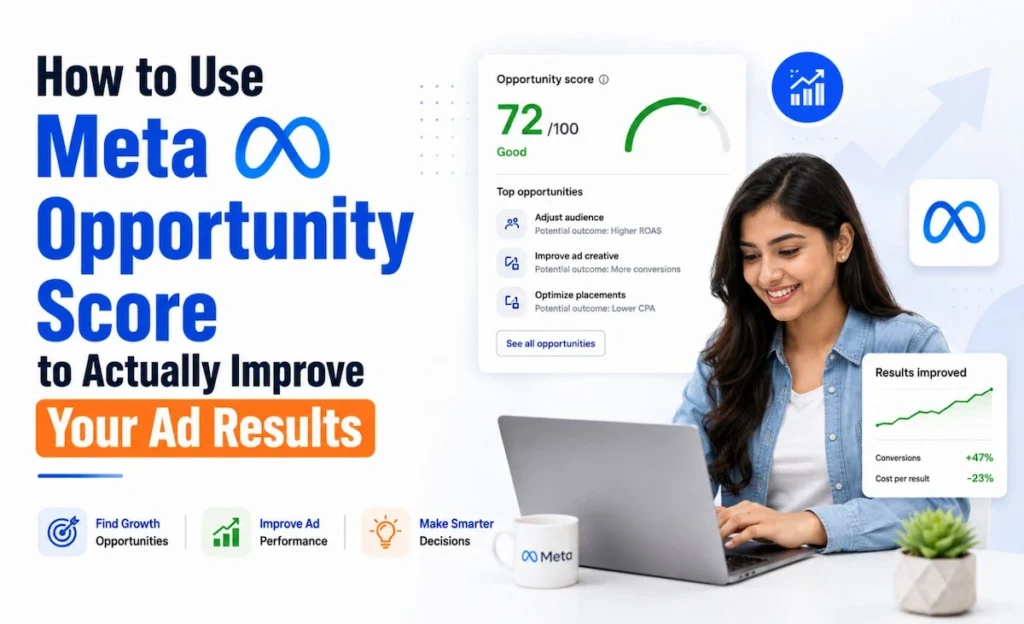
Meta Opportunity Score is a 0 to 100 rating inside Meta Ads Manager that shows how closely your campaigns follow Meta’s recommended best practices. It surfaces the highest-impact fixes first, but a higher score does not automatically mean better ad results.
Think of it like a health checkup report. Your doctor does not tell you whether you will win a marathon. They just tell you what needs attention before you run one.
The score works by scanning your active campaigns and measuring how many of Meta’s recommendations you have applied. Each recommendation carries a weight, and Meta adds those up to give you a single number between 0 and 100. A score of 0 means you are ignoring almost every suggestion. A score of 100 means your campaign setup matches Meta’s preferred structure almost completely.
Here is what the score is actually measuring behind the scenes:
- Whether your pixel is properly installed and firing correctly
- Whether you are using Advantage+ placements or limiting reach unnecessarily
- Whether your audience expansion settings allow Meta enough flexibility
- Whether you have enough creative variety to avoid creative fatigue
- Whether your conversion events are properly mapped and optimized
- Whether you have set up Conversions API or CAPI for stronger signal quality
None of those checks are arbitrary. Each one points to a real gap that can affect your performance if ignored. That is the useful part of the score. The problem starts when advertisers treat that number like a competition.
Where to Find Meta Opportunity Score in Ads Manager
Finding the score is simple once you know where to look. Inside Meta Ads Manager, go to the left-side navigation and look for the Recommendations section. The score appears at the top of that panel along with a breakdown of individual suggestions.
Campaign Level vs Account Level Score
Meta shows two types of scores depending on where you look.
Campaign score reflects how individual campaigns are set up. This is useful when you are auditing a specific campaign for a client or before scaling a budget.
Account-level Opportunity Score gives you a broader view of your overall account health. If you manage multiple campaigns, this number tells you how the whole account compares to Meta’s recommended structure.
For most Indian advertisers managing lead generation or e-commerce accounts, the campaign score is more actionable day to day. The account score is better for monthly reviews or client reporting.
How the Meta Opportunity Score Works
The Scoring Logic
Meta does not share the exact formula publicly, but from what I have observed managing accounts across different industries, the score prioritizes recommendations by estimated impact. If a recommendation could meaningfully reduce your CPA or improve your ROAS, it gets more weight in the score calculation.
This is actually the most useful thing about the score. It is not just a random checklist. It is a priority list that surfaces what is most likely to move the needle in your specific account.
What Affects Your Score the Most
From my experience, the biggest score drops come from three areas.
First, tracking issues. If your pixel is firing incorrectly, or if you have not set up Conversions API (CAPI), Meta has weaker signal data to work with. This shows up quickly as a major drag on your score.
Second, audience fragmentation. Running too many small, overlapping ad sets with similar audiences is one of the most common mistakes I see in Indian accounts. Meta flags this because it forces the algorithm to compete against itself during the learning phase.
Third, creative fatigue. If you are running the same creatives for weeks without rotation, the score picks that up. Meta knows that ad performance decays when audiences see the same creative repeatedly, especially for lead generation campaigns targeting a broad audience.
Types of Recommendations Inside the Score
The recommendations inside Meta Ads Manager fall into a few categories. Understanding which category each suggestion belongs to will help you decide whether to act on it or leave it alone.
Tracking and Measurement Recommendations
These are almost always worth acting on. If Meta is telling you that your pixel is not tracking conversion events properly, or that CAPI is not connected, fix it. Weak tracking means Meta cannot optimize properly. Your CPA will suffer, and your ROAS will look worse than it actually is.
For Indian advertisers using WhatsApp leads as a primary conversion action, this is especially important. Setting up WhatsApp lead tracking through the Conversions API gives Meta much better data to work with, and your score will reflect that improvement quickly.
Audience and Delivery Recommendations
These require more judgment. Meta often recommends audience expansion or switching to Advantage+ targeting, but that is not always right for your specific campaign.
If you are running a campaign for a regional brand with a very specific local audience in Rajasthan, blindly expanding to all of India will hurt your lead quality even if it improves your score. In those cases, ignore the recommendation. Your ROAS and actual conversion data matter more than that number.
Creative Recommendations
When Meta flags creative fatigue or suggests adding more ad variations, that is usually a good signal to act on. More creative variety gives the algorithm more to test, which typically reduces CPA over time.
What to Act on First and What to Ignore
Here is the decision framework I use for my own client accounts, and it has saved me from chasing a number that did not actually matter.
Act on these recommendations immediately:
- Broken pixel or missing conversion event tracking
- CAPI not connected
- Learning phase stuck due to too many ad sets (consolidate)
- No creative variety in active ad sets
- Budget too spread across fragmented audiences
Ignore these recommendations or test carefully:
- Audience expansion suggestions when lead quality matters more than volume
- Advantage+ campaign structure suggestions when you need precise control
- Budget increase suggestions that do not match your actual campaign goals
- Broad targeting recommendations for niche products or local campaigns
The key question to ask before applying any recommendation is simple. Will this improve my CPA, ROAS, or lead quality in my specific account? If you cannot answer yes with confidence, test it in a duplicate campaign before applying it to a live one.
India-Specific Strategy for Meta Opportunity Score
Running ads in India has its own unique dynamics, and the Meta Opportunity Score does not fully account for all of them. Here is what I have learned from managing accounts targeting Indian audiences.
WhatsApp Leads and Score Optimization
For many Indian businesses, especially in real estate, education, and local services, WhatsApp leads are the primary conversion goal. Meta’s recommendations often push toward website conversions or form fills, which may not reflect how your business actually operates.
Set up your WhatsApp lead events through CAPI or the Events Manager so Meta counts them properly. Once your tracking reflects actual business conversions, the score recommendations become much more aligned with real goals.
Lead Quality vs Lead Volume
One of the biggest mistakes I see in Indian ad accounts is chasing lead generation volume at the cost of quality. The score might reward you for expanding your audience or removing targeting restrictions, but if that means filling your CRM with irrelevant leads, the score is steering you wrong.
Always filter score recommendations through your actual lead quality data. If a recommendation increases lead volume but the quality drops, that recommendation is not right for your account.
Budget and Bidding in Indian Markets
Indian markets often see much higher competition during specific seasons, festivals, and regional events. During these periods, the learning phase takes longer because auction dynamics shift fast. Score recommendations around budget consolidation are particularly valuable in these windows because they help Meta exit the learning phase faster and stabilize delivery.
Common Mistakes Advertisers Make with Meta Opportunity Score
Chasing 100 as a Goal
This is the most common mistake. A score of 100 does not mean your campaigns are performing well. It means your setup matches Meta’s preferences. Those are two very different things.
I have seen accounts with a score of 90 plus showing terrible ROAS because the recommendations they applied were wrong for their specific audience and product. The score is a tool, not a trophy.
Applying Every Recommendation Without Testing
Each recommendation changes something in your campaign structure. Applying multiple recommendations at once makes it impossible to know which change caused which result. Always test one recommendation at a time in a separate campaign and measure the impact on CPA and ROAS before rolling it out.
Ignoring the Score Completely
On the other side, some advertisers dismiss the score entirely because they heard it does not matter. That is also wrong. The score is genuinely useful for catching setup errors, especially broken tracking, that silently hurt performance over time.
Quick Checklist: How to Use Meta Opportunity Score the Right Way
Use this as your monthly account audit framework.
- Open Meta Ads Manager and check your campaign score for each active campaign
- Sort recommendations by estimated impact, highest first
- Identify any tracking issues with your pixel or CAPI and fix those first
- Check for audience fragmentation across ad sets and consolidate where needed
- Review creative rotation and add new variations if any set has been running more than three weeks
- For each remaining recommendation, ask: does this align with my CPA, ROAS, or lead quality goals?
- Test any structural change in a duplicate campaign before applying to live campaigns
- Review your Meta Opportunity Score again after two weeks and track the change alongside actual performance metrics
5 Frequently Asked Questions About Meta Opportunity Score
1. What is Meta Opportunity Score?
It is a 0 to 100 rating in Meta Ads Manager that shows how closely your campaign setup follows Meta’s recommended best practices. Higher scores mean more recommendations have been applied.
2. Does a higher Meta Opportunity Score mean better ad performance?
Not always. The score reflects how closely you follow Meta’s structural suggestions, not how well your campaigns are actually converting. A score of 70 with strong ROAS is better than a score of 95 with weak results.
3. Should I apply every recommendation Meta gives me?
No. Use the score to identify real setup problems like broken tracking or audience fragmentation. For recommendations around targeting expansion or campaign restructuring, test them against your actual CPA and lead quality before committing.
4. Why is my Meta Opportunity Score not showing?
Meta notes that availability can vary by advertiser and account type. Some setup issues can also limit full visibility of the score in your account.
5. How do Indian advertisers get the most from Meta Opportunity Score?
For Indian accounts, the score is most useful when paired with real conversion signals like WhatsApp leads, form submissions, and site conversions. Fix tracking issues first, then use the score as a cleanup tool for audience fragmentation and creative fatigue.
2 Quick Tips to Get More From Your Score
Tip 1: Use the score as a cleanup list, not a scoreboard. Your first priority should always be fixing broken tracking, obvious audience fragmentation, missing creative variety, or ignored Advantage+ suggestions. Those are the problems the score is most reliable at catching. Chasing the number for its own sake will not improve your performance.
Tip 2: Do not chase 100 just to hit 100. The better test is always whether a recommendation improves CPA, ROAS, or lead quality in your own account. That is the moment the Meta Opportunity Score becomes a useful tool instead of a distraction.
The day I stopped treating my score as a grade and started treating it as a checklist, my account audits became so much faster. I stopped second-guessing every number and started focusing on what the score was actually pointing me toward, which was fixing the things that quietly hurt my campaigns.
If you are running Meta Ads Manager campaigns in India, especially for lead generation with WhatsApp leads as a primary goal, I hope this breakdown helps you get real value out of a feature that too many advertisers either obsess over or ignore completely.
Start with tracking. Fix fragmentation. Test recommendations one at a time. And keep your eyes on ROAS and CPA as the real scoreboard.