I still remember the first time a small business owner in Jaipur showed me his Google Ads account and asked, “Kirti, why am I paying so much and getting nothing back?” He had heard that PPC for small business was the fastest way to get leads, so he turned on a campaign, set a budget, and waited. Three weeks later, his ad spend was gone and his phone hadn’t rung once.
That conversation is the reason I’m writing this guide. Over the last four years of running Google Ads and Meta Ads for D2C brands, Shopify stores, clinics, and local businesses across India, I’ve seen the same mistake repeat itself. Businesses treat PPC like a lottery ticket instead of a system. If you’re trying to figure out whether PPC for small businesses actually works, how much it costs in India, and how to set it up without wasting money, this article walks through exactly that.
What Is PPC for Small Business?
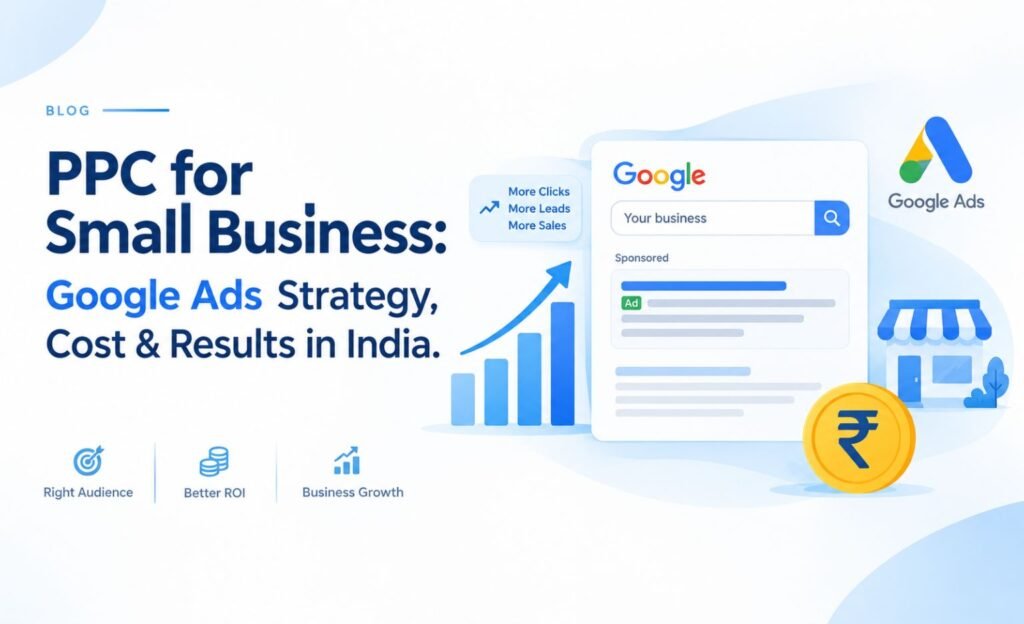
PPC stands for pay-per-click. In simple terms, you pay only when someone clicks your ad. PPC for small business usually happens through Google Ads, where you bid on keywords your customers are already searching for.
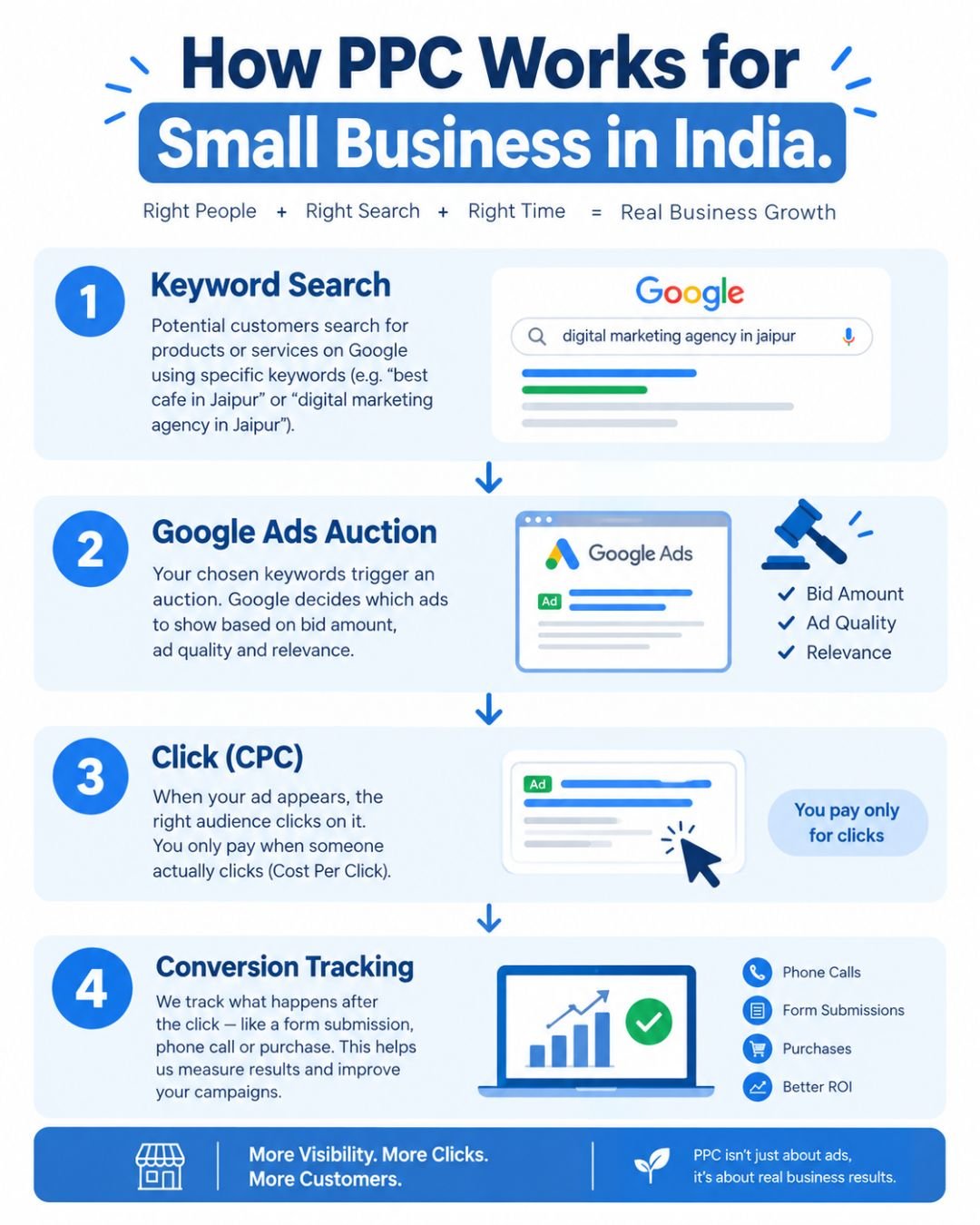
The moment someone searches for something like “best salon near me” or “buy running shoes online,” your ad can appear at the top of the results page. You get charged a small amount, called the cost per click or CPC, only when that person actually clicks through to your website.
How Google Ads Actually Works
Google Ads runs on an auction system. You choose keywords, set a maximum bid, and write ad copy. Google then decides which ads to show based on your bid and something called Quality Score, which measures how relevant your ad and landing page are to the search.
A higher Quality Score often means a lower CPC. This is why two businesses bidding on the same keyword can pay very different amounts for the same click.
PPC vs Organic Traffic
Organic traffic comes from SEO and takes months to build. PPC advertising for small business gives you visibility from day one. Think of PPC as renting attention and SEO as owning it. Most businesses I work with use both together instead of picking one over the other.
Is PPC Worth It for Small Businesses in India?
This is the question I get asked the most, and the honest answer is: it depends on your business model, not your industry alone.
Local Service Businesses
Salons, clinics, gyms, and repair services in Jaipur often see quick results because the search intent is immediate. Someone searching “AC repair near me” wants a solution today, not next week.
Ecommerce and D2C Brands
For small business PPC management in ecommerce, Google Shopping Ads combined with Search Ads usually perform well because buyers are already comparing prices and products.
Clinics, Real Estate and B2B
Real estate and B2B businesses have longer sales cycles. PPC still works here, but the goal shifts from instant sales to qualified leads that a sales team can follow up with.
Even inside the same industry, results vary based on ticket size. A ₹500 product and a ₹50,000 service can’t be judged by the same CPC or conversion rate benchmark, so avoid comparing your account to a competitor’s screenshot without knowing their numbers behind it.
How Much Does PPC Cost for a Small Business in India?
I won’t tell you that ₹20,000 a month is enough for every business, because that’s simply not true. The real cost depends on your industry, your city, and your competition.
Ad Spend vs PPC Management Fee
There are two separate costs to understand:
- Ad spend is the money Google or Meta actually charges for clicks and impressions.
- PPC management fee is what you pay an agency or freelancer to plan, build, and optimise the campaign.
Confusing these two is one of the most common reasons small business owners feel PPC is “too expensive” when the real issue is a poorly structured account, not the platform.
Why CPC Varies by Industry
Local services in tier-2 cities often see a CPC between ₹8 and ₹25. Competitive industries like real estate, finance, or legal services can see a CPC of ₹40 or higher. Ecommerce CPC usually falls somewhere in between, depending on the product category.
Instead of asking “how much should I spend,” a more useful question is: what CPL or CAC can my business afford while staying profitable? That number should decide your budget, not a fixed monthly figure copied from a blog post.
Google Ads vs Meta Ads for Small Businesses
Both platforms work well, but they solve different problems.
- Google Ads captures people who are already searching for what you sell. It’s keyword based and strong for lead generation.
- Meta Ads creates demand by showing your product to people who haven’t searched for it yet. It’s audience and creative based, and strong for discovery and retargeting.
I usually recommend small businesses start with Google Search Ads if they want leads quickly, then add Meta Ads once they have a retargeting audience worth reaching.
How to Set Up a PPC Campaign for a Small Business
This is the section most competitor articles skip over, so let’s go step by step.
- Define your conversion goal. Decide if you want calls, form fills, or online sales before you build anything.
- Research keywords. Focus on high-intent terms your customer would type right before buying.
- Choose match types carefully. Phrase and exact match usually control spend better than broad match for beginners.
- Build tightly themed ad groups. Don’t mix unrelated keywords in one group; it hurts relevance and Quality Score.
- Add negative keywords early. This stops your budget from being wasted on irrelevant searches.
- Write ad copy that matches search intent. Speak directly to the problem your keyword implies.
- Send traffic to a focused landing page, not your homepage. A dedicated page converts far better.
- Set up conversion tracking before launch. Without this, you’re optimising blind. My guide on Google Ads conversion tracking covers this in detail, including GTM and phone tracking setups I use for Indian clients.
- Launch with a realistic daily budget. Give the algorithm enough data to learn.
- Review search terms weekly and remove anything irrelevant.
If you’re already running Search campaigns, it’s worth reading about AI Max for Search campaigns, which acts as an optimisation layer rather than a separate campaign type.
None of these steps need to be perfect on day one. What matters is having all of them in place before you spend a rupee, because fixing a broken foundation later always costs more time and money than setting it up correctly the first time.
PPC Metrics Small Businesses Should Track
Clicks alone tell you very little. Here’s what actually matters:
- CTR (click-through rate): shows if your ad copy is relevant to the search.
- CPC (cost per click): how much each visitor costs you.
- Conversion rate: the percentage of visitors who take action.
- CPL (cost per lead): what each lead actually costs.
- CAC (customer acquisition cost): what it costs to gain a paying customer.
- ROAS (return on ad spend): the revenue you generate for every rupee spent.
A campaign with a low CPC but no conversions isn’t a good campaign. A campaign with a slightly higher CPC but strong conversion tracking and healthy ROAS is the one worth scaling.
Check these numbers weekly rather than daily in the beginning. PPC data needs volume to be reliable, and reacting to a single bad day usually leads to decisions you’ll regret once the full week’s numbers come in.
Common PPC Mistakes Small Businesses Make
I see these mistakes in almost every audit I do:
- Targeting too broad a location or audience
- Using irrelevant or overly generic keywords
- Skipping negative keywords entirely
- Sending all traffic to the homepage instead of a relevant landing page
- Ignoring landing page speed and clarity
- Setting up conversion tracking incorrectly, or not at all
- Changing campaigns every few days before they gather enough data
- Judging performance only by CPC instead of leads and sales
Fixing even three of these usually improves results faster than increasing budget ever will. I’ve audited accounts where simply adding a negative keyword list and rewriting one landing page cut the cost per lead by nearly half within two weeks, without touching the daily budget at all.
When Should You Increase Your PPC Budget?
Here’s a simple rule I follow with every client: don’t increase spend just because impressions went up.
Increase your PPC budget only when conversions are consistent, your cost per lead or CAC stays within an acceptable range, and the customer value justifies scaling. When all three line up, that’s a repeatable result worth investing more into. Without that combination, more budget just means faster, bigger losses.
PPC, Customer Value and Profitability
This is the part most guides never connect properly. A campaign can look “unprofitable” if you only look at the first purchase. But if a customer buys again in three months, the real return looks very different.
I explain this in more depth in my article on customer lifetime value, which walks through how to calculate CLV and use it to decide what CAC you can actually afford. If you’re only measuring your PPC advertising for small business results by the first sale, you’re likely making decisions with incomplete data.
Final Takeaway
PPC for small business doesn’t need a massive budget to work. It needs the right keywords, a relevant landing page, honest tracking, and patience while the data builds up. Start small, watch your numbers closely, and scale only what’s actually working.
If you want a second pair of eyes on your Google Ads or Meta Ads account, you can see how I approach performance marketing for Indian businesses and what a proper audit usually uncovers.
That conversation with the Jaipur business owner I mentioned at the start ended well, by the way. We rebuilt his account keyword by keyword, fixed his tracking, and within six weeks his cost per lead had dropped by more than half. Nothing about it was magic. It was just PPC done properly.
FAQs
Is PPC worth it for a small business?
Yes, when the business has clear conversion goals, relevant search intent, controlled targeting, and reliable tracking in place. PPC can bring in leads or sales faster than organic search typically does, especially in the early stages.
How much should a small business spend on PPC in India?
There’s no fixed number. Your budget should depend on CPC, conversion rate, average customer value, and the CPL or CAC your business can realistically afford.
Is Google Ads better than Meta Ads for small businesses?
It depends on your goal. Google Ads is usually stronger for capturing existing search demand, while Meta Ads works well for creating demand, prospecting new audiences, and retargeting past visitors.
How long does PPC take to work?
Early data can show up within days, but a reliable performance picture usually needs enough clicks and conversions to be meaningful. Avoid judging a campaign after just two or three days.
How do I avoid wasting money on PPC?
Use high-intent keywords, add negative keywords regularly, send traffic to focused landing pages, set up accurate conversion tracking, and review search terms often. Don’t raise your budget simply because traffic increased.
Quick Tip 1: Start narrow. A smaller set of highly relevant keywords is far easier to control and optimise than a campaign trying to target everything at once.
Quick Tip 2: Track leads and sales, not clicks. Clicks tell you people are curious. Conversions tell you the campaign is actually working.